
On Risk
It's about the trade-offs. It's a triangle - like most life principles. Move one of the three vertices and you need to adjust and adpat one or both of the other two.

More often than not, we all think we understand risk. Even more often than that, we think we understand taking chances, but quite often it is very difficult to comprehend how that chance actually translates to risk and, even more importantly, how to measure and calibrate for the risk involved.
Taking a chance is buying a lottery ticket because you feel lucky today. You could also jump a red light as a pedestrian, taking chances even when a car is approaching fast - because you think you will outrun it while it approaches you or because you assume the car will slow down and give you more time than otherwise. And maybe crossing the road with your life at stake is fine, for that moment of need.
Taking a risk and understanding risk are two different things.
Here is my way to look at it. Understanding risk requires three things to come together.
The odds - of something happening, positive or negative - The proabbility of the event.
The payoff - or losses if the event occurs.
The stake - what you actually have at stake, what is already on the table, or what you need to put on the table to get the payoff.
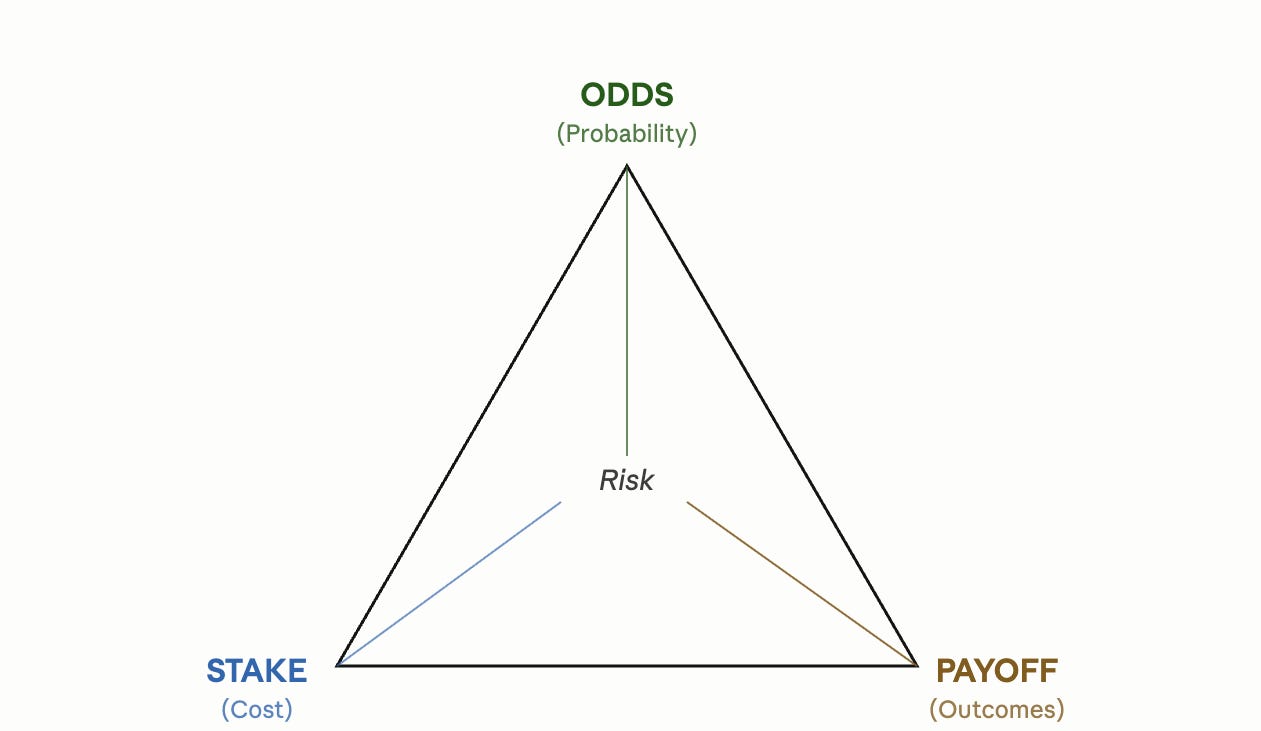
Miss any one of those three, and you have not assessed the risk. You have an intuition, a guess, and you could still be right. But that is not the same thing as knowing the exact risk.
We live in a time of genuine uncertainty. Not just economic or geopolitical, but also personal. Career paths that were predictable for a generation have compressed into five year windows. Technologies that took decades to mature now reshaping industries in months. The uncertainty is not going away, which makes understanding risk not just intellectually interesting but practically necessary.
Here is a simple way to think about it.
Imagine two bowls in front of you. Bowl one has ten tickets. One says bingo (the winning ticket). Nine are empty. If you draw the bingo, your win is ten times whatever you put in. Bowl two has a hundred tickets. One says bingo. Ninety nine are empty. If you draw the bingo, you win a hundred times whatever you put in. Empty tickets leave you empty. So these are binary bets. Most bets in life are not, though.
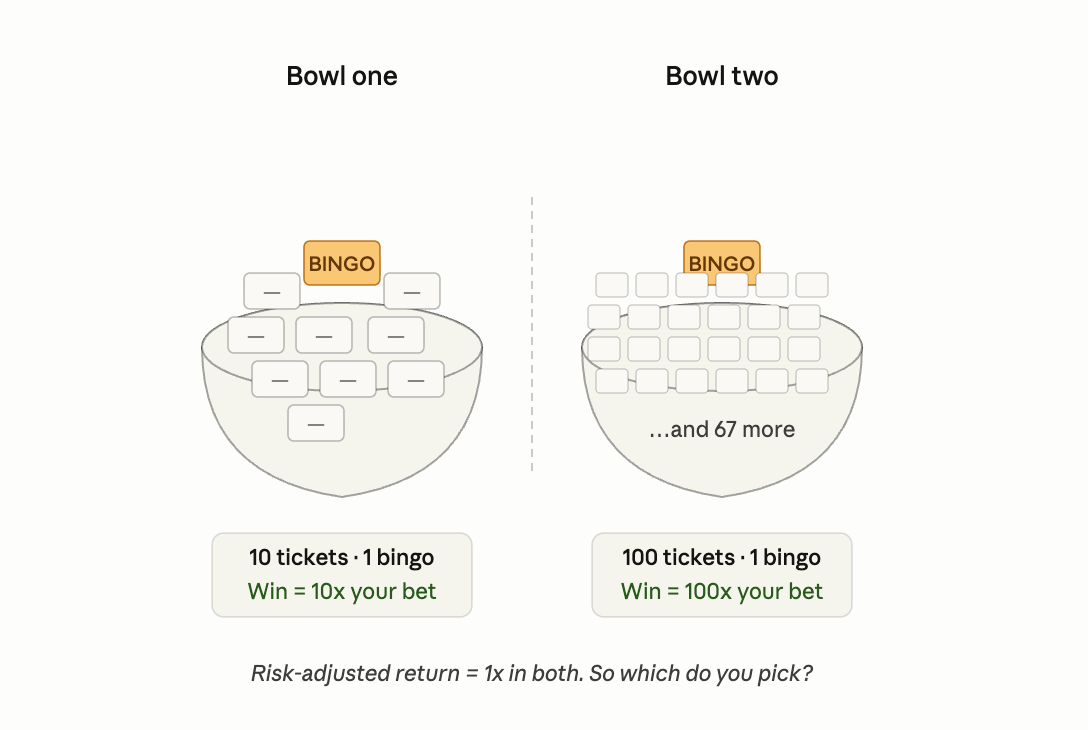
So which bowl do you pick?
In pure math, both bets are equal. Ten percent odds with a ten times payoff. One percent odds with a hundred times payoff. Risk adjusted, both return exactly one. Symmetrical bets with no edge either way.
Most people have an instinct. Some go for the higher odds because it appears less risky on the surface with 10% odds of winning instead of 1%. Some go for the bigger payoff because they think they have higher appetite for the risk. But the important aspect before any answer to that question is actually another question. What is the minimum you have to put in?
Ofcourse there is no right answer between the two bowls because it varies for each person.
If you are betting 1$, bowl two could make sense. The downside is negligible. The upside could pay for a meal. But if you are betting your life savings, bowl one is the only rational choice - if you were literally forced to play. Ten percent odds of winning beats one percent when losing means ruin. The math did not change. What changed is what you have at stake.
This is what most conversations about risk often miss - looking at all three. People debate probabilities and potential returns endlessly. They rarely sit with the third question. What am I actually willing to lose here? Not what sounds acceptable in theory. What is truly at stake.
Now change the bowl slightly. Bowl two still has a hundred times payoff. But now it has ninety nine tickets instead of a hundred. One bingo, ninety eight empty. Suddenly the math shifts. Bowl two now has a real edge. Not a dramatic one, but a real one. The risk adjusted return is just above one. Mathematically bowl 2 is a superior bet.
And yet the stake question does not go away. The edge is real, but if the downside is catastrophic for you, the edge does not save you.
This is the triangle at the heart of every risk decision. Odds. Payoffs. Stake. Move one, and the others are forced to respond.
Higher payoffs almost never come without either worse odds or a higher stake.
Better odds rarely come free. Either you mitigate risks by investing more into risk mitigation or choose lower returns.
The pursuit of a free lunch, i.e. a higher return with no additional risk, is either a once in a generation insight or a sign that someone has not done enough work with the triangle.
Most people who say they are comfortable with risk are comfortable taking chances. But, understanding risk rquires understanding tradeoffs.
Understanding risk does not mean taking less of it. It means taking it with your eyes open. Knowing what you are putting in. Knowing what you stand to gain. And being honest about what losing would cost you.
That honesty is rarer than people would want it to be.
Great read!
Instead of just thinking about the risk-reward ratio, I’m now inclined towards considering stake as a third variable.
Super insightful, Ankur!
And I totally agree, that nowadays understanding risks in general and financial risk management in particular should be considered a basic matter within the children’s curriculum at school.
Cool!